
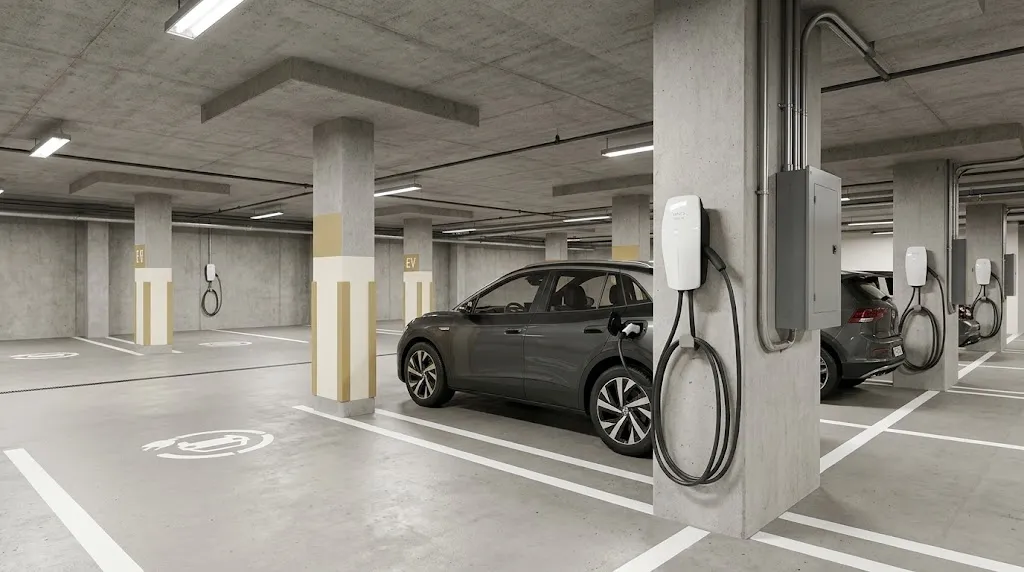
This guide explains shared electrical capacity, static and dynamic control, connectivity, phased expansion and resident billing. It provides planning questions for evaluating a proposal. Electrical design limits and equipment settings must be established for the actual property by the qualified project team.
EV charger load management for condos distributes charging demand within defined electrical limits. Static arrangements use a predetermined charging budget, while dynamic arrangements adjust charging in response to measured demand or available capacity. Either approach needs suitable equipment, a site-specific electrical assessment and documented operation during communication or power failures.
What Is EV Charger Load Management for Condos?
EV charger load management is the coordinated control of electrical demand from charging equipment. Depending on the design, it can limit an individual charger, a group of charging ports or charging demand associated with a particular feeder or building service.
The charging equipment is commonly called electric vehicle supply equipment, or EVSE. A system designed to manage its demand may be described as an electric vehicle energy management system, or EVEMS.
How the Main Components Work Together
A proposed installation should explain the responsibilities of its main components:
- Measurement: Identifies relevant electrical demand where the design requires monitoring.
- Control: Determines the charging allowance within the established limits.
- Charging equipment: Applies supported charging limits or operating instructions.
- Administration: Provides the agreed monitoring, access, reporting and billing functions.
A dashboard showing electricity use is not, by itself, evidence that demand is being controlled. Ask how the system enforces its limits and which functions remain available if the management platform becomes unreachable.
Smartopia’s condo EV charging services address charging infrastructure, networking, user access and expansion requirements as parts of one project scope.
Why Is Electrical Capacity a Challenge in Condo Garages?
Charging introduces additional demand into a property that already supplies building equipment and occupied spaces. Available capacity depends on the electrical system, existing demand, distribution arrangements and planned future loads.
Several residents may connect their vehicles during the same evening period. The assessment must consider that pattern alongside the building’s other demands rather than assuming each charger will operate independently.
Capacity Must Be Checked Throughout the Electrical Path
A building may have capacity at one point and a constraint elsewhere. The project team needs to assess the relevant service, feeders, panels, circuits and associated equipment.
Spare spaces in a panel do not establish that enough electrical capacity is available. Similarly, a utility bill alone may not provide the detail needed to evaluate every part of the proposed charging distribution.
Future Building Changes Also Matter
The assessment should account for confirmed or reasonably planned changes, such as additional charging ports or building electrification projects. Capacity assigned to charging today may need to be reviewed when other electrical loads change.
EV charger load management for condos can help control the charging portion of demand. It does not create additional electrical capacity or remove the need to assess existing infrastructure.
Static vs Dynamic EV Charger Load Management for Condos
Static load management generally works within a predetermined charging allowance. Dynamic load management changes the allowance or allocation in response to monitored conditions. Suppliers may use these terms differently, so compare the actual measurement and control functions in each proposal.
| Consideration | Static Arrangement | Dynamic Arrangement |
|---|---|---|
| Charging allowance | Uses a predetermined limit for the relevant charging equipment | Adjusts charging according to the monitored conditions and configured limits |
| Allocation between vehicles | May divide or schedule power within the fixed allowance | May redistribute power as charging activity or available capacity changes |
| Measurement requirements | Depend on how the fixed allowance is established and enforced | Depend on which building or charging loads the system monitors |
| Main planning question | Will the fixed allowance meet the expected charging requirement? | How is available capacity measured, controlled and maintained during faults? |
| Expansion consideration | More ports may share the same total allowance | More ports still depend on the available capacity and control-system limits |
Load Sharing and Building-Demand Control
Sharing power between several chargers and adjusting EV demand against building demand are related functions, but they are not identical.
One system might divide a fixed allowance between charging ports. Another might monitor a building feeder and vary the charging allowance as other demand changes. A project can combine both approaches.
Ask the supplier to identify exactly what is monitored, what is controlled and where each limit applies.
How Charging Capacity Is Shared Between Vehicles
A charging system can distribute its available allowance using supported allocation rules. Those rules may divide capacity, rotate charging opportunities or apply an agreed priority. The available functions depend on the equipment and platform.
Common Allocation Approaches
- Shared allocation: Distributes the available allowance between participating charging sessions.
- Sequential or rotating operation: Gives vehicles charging opportunities according to a defined sequence.
- Configured priorities: Applies approved rules for particular users or operating requirements where supported.
- Scheduled operation: Allows charging during agreed periods, subject to the electrical limits.
The vehicle also affects the power it accepts. A platform should not be assumed to know a vehicle’s battery state, intended departure time or required energy unless that information is actually available and supported.
An Illustrative Power-Sharing Example
Consider a hypothetical charging allowance of 24 kW shared equally between eight vehicles. If the entire allowance remains available and all eight vehicles accept their allocation, each would receive an average of 3 kW.
| Illustrative Assumption | Value |
|---|---|
| Constant total charging allowance | 24 kW |
| Vehicles sharing equally throughout the period | 8 |
| Average allocation per vehicle | 3 kW |
| Illustrative charging period | 8 hours |
| Theoretical energy per vehicle before charging losses | 24 kWh |
This is an arithmetic example, not a design recommendation or charging guarantee. Actual energy depends on changing availability, vehicle behaviour, charging losses, equipment limits and interruptions. The example does not establish suitable circuit ratings or other electrical design values.
The distinction matters: kW describes power at a point in time, while kWh describes energy delivered over time. Residents need an assessment of expected energy over their parking period, not simply the maximum output printed on a charger.
What Building Data Is Needed Before System Design?
Before selecting EV charger load management for condos, the project team needs reliable information about the electrical infrastructure, existing demand, parking arrangements and anticipated use.
| Information | Why It Matters |
|---|---|
| Available electrical drawings and equipment records | Help identify the proposed supply path and existing distribution |
| Relevant demand records or measurements | Support assessment of existing loads and available capacity |
| Condition and ratings of relevant equipment | Help identify constraints beyond the main service |
| Parking layout and cable routes | Affect installation access, distribution and future expansion |
| Expected users and parking periods | Help assess the charging service residents may receive |
| Connectivity conditions | Inform communication methods and fault-response planning |
| Other planned electrical projects | Identify future demands that may affect the charging proposal |
Use a Site-Specific Electrical Assessment
The appropriate records, measurement period and calculation method should be determined by the qualified designer and contractor according to the project and applicable requirements.
A resident-interest survey can help forecast demand, but it does not replace an electrical assessment. Similarly, a previous installation elsewhere does not establish the capacity available in this building.
Define Roles Before Procurement
Identify who is responsible for electrical design, regulated installation work, networking, software configuration and ongoing support.
ESA states that a Licensed Electrical Contractor must file a notification before an EV charger installation and provide the Certificate of Acceptance after the completed work is accepted. Keep the relevant project documentation with the building’s records.
Charger Connectivity and System Monitoring
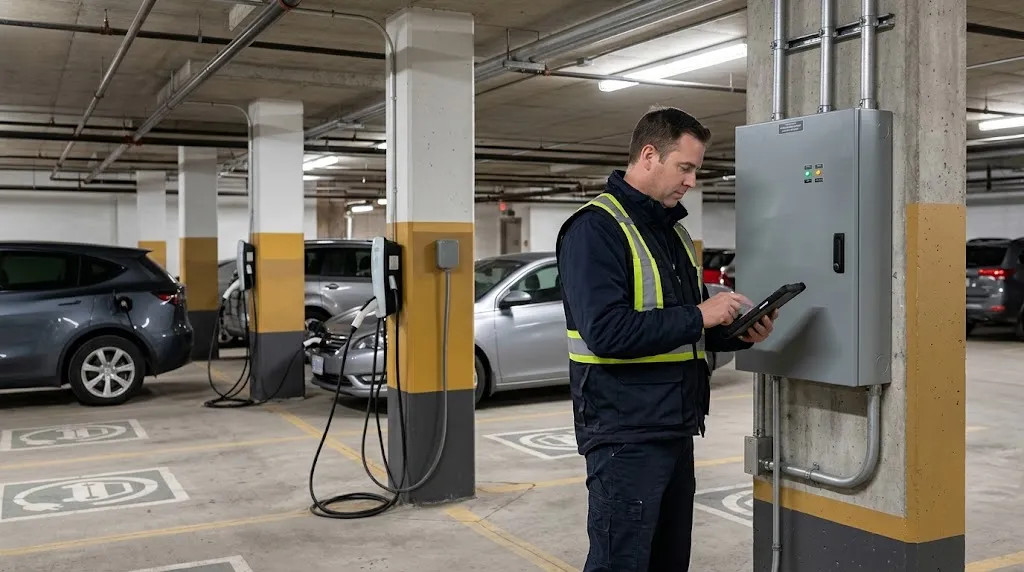
Connectivity can support charging control, user authorization, reporting and billing. These functions may depend on different network connections, so their failure behaviour should be documented separately.
Distinguish Internet, Local Network and Measurement Faults
| Event | Question for the Supplier |
|---|---|
| Internet connection is lost | Which charging and administrative functions continue locally? |
| A charger loses its local communication link | What controlled operating state applies to that charger? |
| Relevant measurement information is unavailable | How are the established electrical limits maintained? |
| The management platform is unavailable | How are authorization, control and session records handled? |
| Power returns after an interruption | How is charging restored without exceeding the configured limits? |
Offline operation is equipment- and configuration-dependent. A statement that a charger “works offline” should be supported by an explanation of which functions continue and which limitations apply.
Confirm Interoperability in the Actual System
A claim of support for a communication protocol such as OCPP should be checked against the required versions, features, firmware and management platform. The project team should verify the specific control functions needed for the installation.
Plan communication infrastructure alongside the property’s network cabling. Underground coverage, equipment placement and local network design should be assessed rather than assumed.
Agree on Commissioning Tests
Include tests for charging allocation, demand changes, connection failures, recovery, user access and session records within the qualified team’s commissioning scope.
For the wider project sequence and handover requirements, see Smartopia’s EV charger installation guide.
How Load Management Supports Phased Expansion
EV charger load management for condos can support a phased installation when the electrical, communication and administrative design allows additional ports to be introduced within defined limits.
Adding charging ports does not automatically add more energy capacity. If a fixed allowance is shared between more simultaneous users, the charging opportunity available to each user may change.
Separate Infrastructure Planning From Charger Quantity
A phased plan can distinguish the initial equipment installation from the pathways, distribution arrangements and network infrastructure needed for later stages.
Ask what each future stage requires. Expansion may involve more than purchasing another charger, particularly if additional distribution equipment, communication devices or software licences are needed.
Set Review Triggers
Agree when the charging design should be reviewed. Relevant triggers may include an increase in simultaneous use, repeated unmet charging needs, a new building load or a proposed additional phase.
Assess whether the available charging window and energy budget still meet the agreed service objective. Avoid promising unrestricted expansion without identifying the conditions that would require a redesign or electrical upgrade.
Keep Configuration and Ownership Records
Maintain drawings, equipment identifiers, configured limits, account ownership and support contacts. A change in management company or software provider should not leave the corporation unable to administer its charging infrastructure.
Resident Experience, Access and Billing Considerations
Residents need to understand how charging access is assigned, why charging power may change and how charges are calculated. Electrical load management and resident billing should be evaluated as separate functions.
Explain the Charging Service Clearly
Describe the expected parking and charging arrangement in language residents can understand. Explain whether spaces are assigned or shared, how access is authorized and what happens when demand is high.
Publish a clear support process for failed sessions, account changes and equipment faults. Confirm how access is removed or transferred when residents move or parking arrangements change.
Make Fees and Measurement Transparent
Potential charges may include electricity, platform subscriptions, administration or other agreed services. The corporation should understand which costs are shared and which are assigned to participating users.
Time-based fees deserve particular attention when charging power varies. Explain how the chosen fee model operates during reduced-power periods and how disputes will be handled.
Where billing is based on measured energy, confirm the applicable metering and administrative requirements with the supplier and relevant authorities. Measurement Canada provides guidance on EV charging measurement and billing; the appropriate arrangement depends on how the equipment is used.
Protect Administrative Access and Resident Records
Assign appropriate account permissions and define who can view charging records, change fees or export resident information. Confirm what happens to the records and accounts if the service provider changes.
These arrangements should be coordinated with the property’s wider residential technology operations.
9 Questions a Condo Board Should Ask Before Approval
Before approving EV charger load management for condos, request written answers to the following nine planning questions. They help establish the proposal’s scope, assumptions and operating responsibilities.
- What electrical assessment supports the proposal? Identify the designer, relevant infrastructure and evidence used to establish the charging allowance.
- Where do the control limits apply? Ask which service, feeder, panel or charging group is protected by each limit.
- How is demand measured and controlled? Confirm the actual functions rather than relying only on labels such as “smart” or “dynamic.”
- What charging experience is expected? Request the assumptions about simultaneous users, parking periods and available energy.
- What happens during faults and recovery? Document responses to internet, local network, measurement and power interruptions.
- Who handles approvals and electrical acceptance? Identify responsibilities for the applicable condo process, utility coordination and ESA documentation.
- How do access, metering and billing work? Review account ownership, fees, records and applicable measurement requirements.
- What changes when more chargers are added? Define expansion costs, capacity constraints and review triggers.
- What support and handover are included? Confirm drawings, configuration records, training, fault response and provider-transition arrangements.
Ontario’s condo approval process differs between installations initiated by an owner and those initiated by the corporation. The Condominium Authority of Ontario’s EV charging guide provides information and templates for those processes.
Load-management capability does not replace the required approval and electrical assessment process. It should form part of a documented proposal that explains the equipment, responsibilities and limits.
Smartopia supports EV charging planning for condos in Toronto and the GTA. Share the building’s existing information, parking layout and proposed charging requirements to discuss an appropriate assessment and project scope.
Frequently Asked Questions
Can a condo add more chargers without upgrading its electrical service?
Sometimes. A suitable load-management arrangement may allow additional charging ports within an assessed electrical allowance. The result depends on existing demand, distribution capacity, expected charging use and applicable requirements. More ports may share the same total allowance, so the resident charging experience must also be assessed.
Will load management make every vehicle charge more slowly?
Not necessarily at every moment. Charging power may be reduced when demand exceeds the available allowance, then increased when capacity becomes available, where the system supports that operation. Actual charging depends on the allocation rules, connected vehicles, building conditions and the vehicle’s accepted charging rate.
What happens if charger connectivity is interrupted?
The response depends on the equipment, network architecture and configuration. Charging may continue under defined local limits, operate in a restricted mode or pause. Confirm which connection has failed and require the supplier to document and test the intended behaviour, including how electrical limits and session records are maintained.
Who should assess the building’s available electrical capacity?
A qualified electrical designer or professional engineer, where required for the project, should assess the relevant capacity in coordination with the Licensed Electrical Contractor and utility as applicable. The assessment needs to consider existing demand and the proposed supply path, not simply spare panel spaces or the number of requested chargers.

Comments are closed