
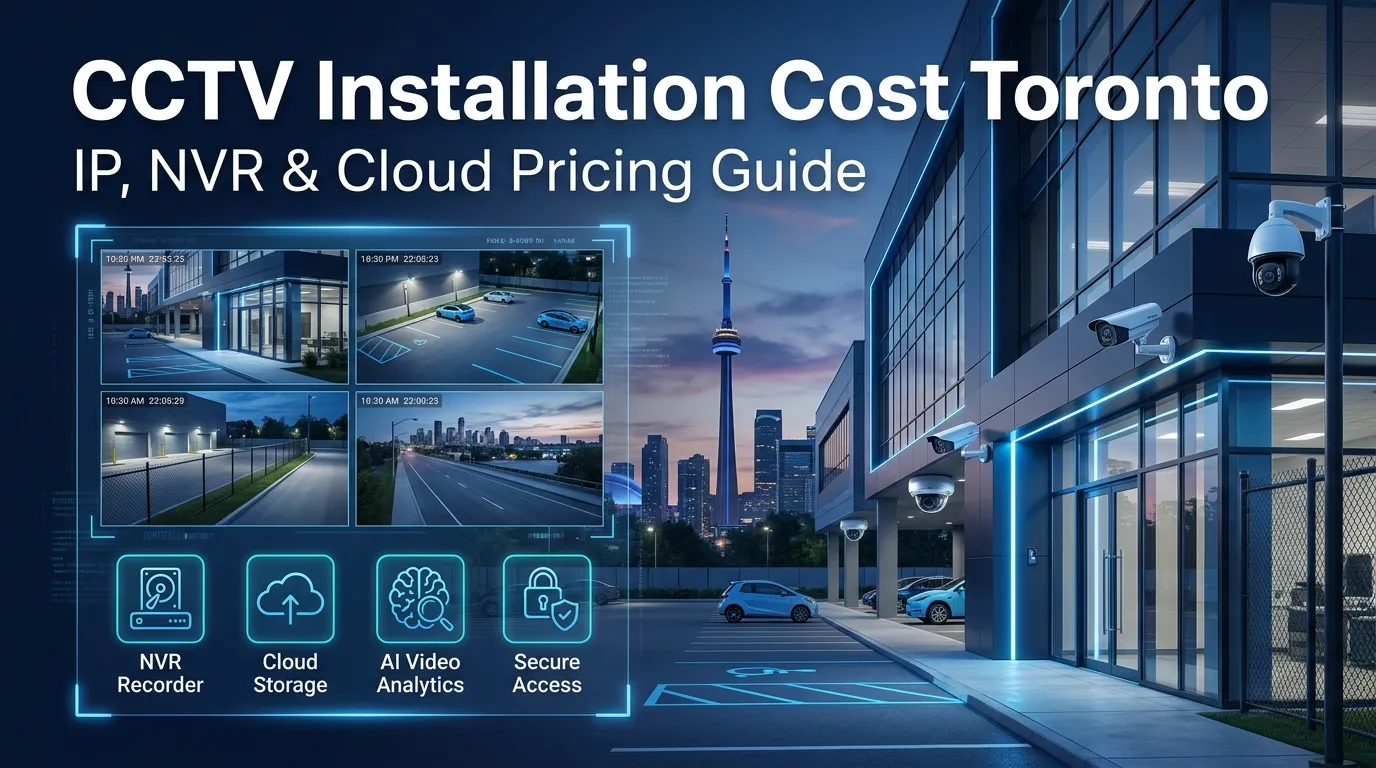
When comparing prices for CCTV installation in Toronto, business owners should look beyond the advertised cost per camera. Camera resolution, low-light performance, structured cabling, recording hardware, storage capacity, cybersecurity, remote access and ongoing licensing all affect the actual cost of owning the system.
This guide explains the expected cost ranges for analog, IP, NVR and cloud-managed CCTV systems. It also shows how to compare installation quotes and estimate the long-term cost of protecting a commercial property in Toronto and the Greater Toronto Area.
Pricing note: All figures below are general planning estimates in Canadian dollars, before applicable taxes. Final pricing depends on the property, equipment selection, installation conditions and system requirements.
How Much Does CCTV Installation Cost in Toronto?
A professionally installed commercial CCTV system in Toronto may cost anywhere from approximately $2,000 for a small, straightforward installation to tens of thousands of dollars for a warehouse, multi-floor office, condominium or multi-site commercial environment.
Here is a practical starting point for budget planning:
| Commercial property size | Typical camera count | Estimated installed cost | Common application |
|---|---|---|---|
| Small site | 4–8 cameras | $2,000–$4,500 CAD | Small office, clinic, shop or restaurant |
| Medium site | 8–16 cameras | $4,500–$10,000 CAD | Retail store, office floor or small warehouse |
| Large site | 16–32 cameras | $10,000–$25,000+ CAD | Warehouse, condominium or multi-floor building |
| Enterprise or multi-site | 32+ cameras | Custom-designed pricing | Campuses, industrial facilities and property portfolios |
These ranges normally assume commercial-grade equipment, professional mounting, cabling, recorder configuration, mobile access and system testing. They may not include major network upgrades, lifts, trenching, electrical work, cloud subscriptions or extensive integration with other building systems.
If you already know the approximate number of entrances, public areas and exterior zones that require coverage, Smartopia can help you plan a suitable security camera installation in Toronto.
What has the greatest effect on CCTV installation pricing?
The main cost drivers are:
- Number and type of cameras: Fixed cameras usually cost less than multi-sensor, thermal, panoramic or license-plate cameras.
- Image requirements: Identifying a face or licence plate requires more detailed design than observing general activity.
- Cable routes: Finished ceilings, concrete walls, long distances and restricted areas can increase labour and material costs.
- Indoor or outdoor placement: Exterior cameras may require weather-resistant housings, junction boxes, surge protection and high-access equipment.
- Recording period: Keeping video for 30, 60 or 90 days requires more storage than short-term retention.
- Network readiness: IP cameras may require PoE switches, VLAN configuration, network racks or additional data cabling.
- Analytics: People counting, line crossing, licence-plate recognition and advanced object detection can require specialized cameras or licences.
- System integration: Connecting CCTV with access control, intercoms or building platforms adds configuration and testing work.
- Ongoing support: Preventive maintenance, software updates, health monitoring and response-time requirements affect long-term cost.
CCTV Installation Cost Per Camera for Commercial Properties
A useful planning range for a professionally installed commercial security camera is approximately $300–$900 CAD per standard camera location. However, dividing a complete quote by the number of cameras can be misleading because every project also includes shared equipment and services.
| Camera or installation type | Estimated installed cost per location | Suitable use |
|---|---|---|
| Standard indoor analog camera | $250–$500 CAD | Basic observation in existing analog systems |
| Standard commercial IP camera | $400–$900 CAD | Offices, retail, entrances and common areas |
| Outdoor vandal-resistant IP camera | $550–$1,200 CAD | Parking areas, loading zones and building exteriors |
| Panoramic or multi-sensor camera | $900–$2,500+ CAD | Large open spaces requiring broad coverage |
| PTZ, thermal or licence-plate camera | $1,200–$4,000+ CAD | Perimeters, vehicle entrances and specialized security |
A per-camera figure may include the camera, mount, cable, connectors, labour and basic configuration. It may not include the NVR, hard drives, PoE switches, rack equipment, network improvements, cloud licences or elevated-access equipment.
Why can two camera locations have different installation costs?
An indoor camera mounted near an accessible suspended ceiling may require a relatively short cable run. An outdoor camera on a warehouse wall may require weatherproof containment, a lift, longer cabling and additional protection. Although both locations use one camera, their installation requirements are very different.
For IP surveillance, a reliable network is part of the security system. Properties with aging or undocumented infrastructure may benefit from professional network cabling in Toronto before cameras are deployed.
Analog CCTV vs IP Cameras: Initial and Long-Term Costs
Analog CCTV generally has a lower initial equipment cost, while IP cameras provide higher resolution, easier expansion and more advanced system features. The right choice depends on the existing infrastructure, image-quality requirements and long-term plans for the property.
| Cost factor | Analog CCTV | IP camera system |
|---|---|---|
| Initial camera cost | Usually lower | Usually higher |
| Cabling | Coaxial cable plus power, unless using compatible converters | Ethernet cable can carry data and PoE power |
| Recorder | DVR | NVR, server or cloud platform |
| Image quality | Adequate for many basic applications | Better support for high-resolution and detailed video |
| Scalability | May be limited by DVR channels and legacy cabling | Generally easier to expand across a suitable network |
| Analytics | Limited or recorder-dependent | Broader edge and server-based analytics options |
| Long-term flexibility | Best when preserving usable existing infrastructure | Better suited to scalable and integrated environments |
When does analog CCTV still make financial sense?
Analog may remain practical when a property already has serviceable coaxial cabling and only needs improved cameras or a newer DVR. Reusing compatible infrastructure can reduce disruption and installation labour.
The condition of existing cables and connectors should be tested before an upgrade. Old cabling that produces unstable video or cannot support the required technology may create recurring maintenance costs that offset the initial saving.
When is an IP camera system worth the higher cost?
IP CCTV is usually the stronger long-term option when a business needs high-resolution footage, centralized management, flexible expansion, remote administration or integration with other security systems. It is also suitable for properties that want to use analytics at entrances, loading areas or sensitive zones.
For a new development or major renovation, installing properly planned network cabling from the beginning can make future camera additions faster and less disruptive.
Local NVR vs Cloud CCTV vs Hybrid Recording Costs
The recording method changes both the initial project cost and the recurring operating cost. Commercial CCTV systems commonly use a local NVR, cloud-managed recording or a hybrid of the two.
Local NVR CCTV costs
A local network video recorder stores footage on hard drives installed at the property. A small commercial NVR and surveillance-grade storage may add approximately $700–$3,000 CAD to a project, depending on channel capacity, storage size, redundancy and performance.
Larger recorders, servers and redundant storage systems may cost considerably more.
Local NVR advantages include:
- No mandatory per-camera cloud recording fee for many systems.
- High-capacity local recording can be cost-effective over several years.
- Recording can continue during an internet outage when the local system remains operational.
- The business maintains direct control over its on-site recording hardware.
Potential additional costs include:
- Recorder and hard-drive replacement.
- Secure rack space, cooling and backup power.
- Remote-access configuration and cybersecurity management.
- Maintenance and storage expansion as the camera count grows.
Cloud-managed CCTV costs
Cloud CCTV reduces the amount of recording hardware required on-site, but it normally introduces recurring licence and storage charges. Depending on the provider, features and retention period, planning costs may range from approximately $15–$60+ CAD per camera per month.
Some enterprise platforms cost more when they include advanced analytics, centralized multi-site management, extended retention or managed monitoring.
Cloud CCTV advantages include:
- Centralized access across multiple properties.
- Simplified software updates and platform administration.
- Predictable subscription-based operating expenses.
- Reduced dependence on a large recorder located at one property.
Potential additional costs include:
- Ongoing per-camera subscriptions.
- Higher internet bandwidth requirements.
- Retention upgrades and analytics licences.
- Possible migration or replacement costs if the business changes platforms.
Hybrid CCTV costs
A hybrid system combines local recording with cloud management, cloud backup or off-site storage for selected events. It can provide a useful balance between on-site resilience and centralized remote access.
The initial cost may be higher because the system requires local hardware and cloud services. However, a hybrid design can control recurring storage costs by sending only selected events or critical footage to the cloud instead of continuously uploading every camera.
| Recording model | Initial cost | Recurring cost | Best suited to |
|---|---|---|---|
| Local NVR | Medium to high | Low to medium | Single sites and high local storage requirements |
| Cloud-managed CCTV | Low to medium | Medium to high | Multi-site businesses and centralized management |
| Hybrid recording | Medium to high | Medium | Businesses needing local resilience and cloud access |
Remote Monitoring, AI Analytics, Storage and Integration Add-Ons
A basic CCTV quote may cover cameras and recording, while a complete commercial security solution may include several additional capabilities. These features should be identified during the design stage so the system, network and storage can support them properly.
Remote viewing and system management
Many modern NVR and cloud systems support remote viewing from authorized computers and mobile devices. Basic remote access may be included, while managed health monitoring, multi-site administration and custom user permissions may add setup or subscription costs.
Remote access should be configured securely. Default passwords, shared accounts and unnecessary internet exposure create avoidable risks. A professional design should include strong credentials, role-based access, current firmware and appropriate network separation.
AI video analytics
AI-enabled cameras and video platforms can filter routine motion and highlight more relevant activity. Depending on the selected equipment, analytics may be included with the camera, licensed per device or processed by a dedicated server.
Common commercial analytics include:
- Person and vehicle classification.
- Line-crossing and intrusion detection.
- People counting and occupancy insights.
- Loitering or dwell-time alerts.
- Object-left or object-removed detection.
- Licence-plate recognition.
- Search by time, zone or object characteristics.
Analytics should support a clearly defined operational need. Paying for unnecessary features adds complexity without improving security outcomes.
Access-control integration
Integrating CCTV with door access events can help security teams review who entered a controlled area and what occurred at the same time. Costs vary according to platform compatibility, the number of doors, licensing and the required automation.
Businesses planning a combined solution can review Smartopia’s approach to access control systems in Toronto.
Network and Wi-Fi improvements
Wired PoE connections are generally preferred for fixed commercial cameras because they provide consistent power and network connectivity through one cable. Wireless connectivity may be suitable in selected situations, but signal strength, interference and power availability must still be considered.
Properties with multiple floors, shared facilities or extensive coverage requirements may also require a broader building-wide network and Wi-Fi strategy.
Backup power and system resilience
A UPS can keep the NVR, network switches and selected cameras operating during a short power interruption. Critical facilities may require longer backup time, generator integration, redundant storage or failover connectivity. These measures increase project cost but may be essential where video continuity is a business or security requirement.
How Much Storage Is Required for 30 Days of CCTV Recording?
Quick answer: A 4MP H.265 IP camera recording continuously at approximately 2–6 Mbps may use around 0.65–1.95 TB for 30 days. Eight cameras at those settings could therefore require roughly 5.2–15.6 TB of raw storage before allowing for overhead, redundancy or changes in recording conditions.
A practical calculation is:
Storage in GB per day = bitrate in Mbps × 10.8
For example:
- A camera recording at 2 Mbps uses approximately 21.6 GB per day.
- Over 30 days, that camera uses approximately 648 GB.
- Eight similar cameras use approximately 5.2 TB over 30 days.
Actual storage use depends on:
- Camera resolution.
- Frames per second.
- H.264 or H.265 compression.
- Scene complexity and movement.
- Continuous, scheduled or motion-based recording.
- Audio recording.
- Retention period.
- Primary and redundant recording requirements.
Motion-based recording can reduce storage use, but it should not be selected only to reduce cost. Poorly configured motion detection can miss important activity or generate excessive recordings. Storage should be calculated after confirming the required image quality and retention policy.
How to Compare CCTV Quotes and Calculate Total Cost of Ownership
The cheapest installation quote is not automatically the lowest-cost system. A useful comparison should cover equipment, installation, documentation, recurring fees, support and expected future expansion.
1. Confirm the security objective for every camera
Each proposed location should have a defined purpose, such as observing an area, recognizing a person, identifying a face or capturing a licence plate. A quote that lists camera quantities without explaining coverage objectives may not provide enough information to evaluate performance.
2. Compare equivalent equipment specifications
Confirm whether each quote specifies:
- Camera manufacturer and model.
- Resolution, lens and field of view.
- Low-light and infrared capabilities.
- Indoor, outdoor and vandal-resistance ratings.
- Recorder model and available channels.
- Usable storage capacity and estimated retention.
- PoE switch capacity and power budget.
- Warranty and replacement terms.
3. Review the installation scope
A complete scope should state whether pricing includes cable pathways, terminations, labelling, mounting hardware, patching, lifts, permits, testing, user setup, mobile configuration and removal of old equipment.
4. Identify recurring charges
Ask for a clear list of cloud storage, software licences, monitoring, cellular backup, maintenance and support fees. Compare the cost over at least three to five years.
5. Check cybersecurity and user-management provisions
Confirm how the system will handle passwords, administrator access, firmware updates, remote connections and staff permissions. Cybersecurity should be treated as part of the installation—not as an optional feature added after deployment.
6. Ask about commissioning and handover
The final handover should include camera names, recorder settings, user roles, basic operating instructions and relevant system documentation. For larger projects, marked-up plans and a device schedule make future maintenance and expansion easier.
7. Calculate the total cost of ownership
A basic five-year comparison can use the following formula:
Five-year CCTV cost = equipment + installation + network upgrades + five years of licences and monitoring + estimated maintenance and replacements
For example, a lower-priced cloud camera system may have a smaller initial cost but higher subscription expenses. A local NVR system may cost more at installation but have fewer recurring storage fees. The better value depends on the required retention, number of cameras, support model and expected life of the system.
Can an Existing CCTV System Be Upgraded Gradually?
Yes. Many existing CCTV systems can be upgraded in phases, provided the current cabling, recorder, network and cameras are compatible with the proposed design.
A phased upgrade may involve:
- Testing existing coaxial and network cables.
- Replacing the recorder and storage first.
- Upgrading priority entrances and exterior areas.
- Adding PoE switches and structured cabling where needed.
- Migrating remaining analog cameras over time.
- Integrating access control or analytics during a later phase.
A hybrid recorder or compatible encoder may allow older analog cameras to remain operational during the transition. However, preserving unreliable equipment solely to reduce immediate spending may increase service calls and limit image quality.
Before deciding, compare the cost of a phased migration with the labour and disruption required to maintain two technologies simultaneously.
What Should Be Included in a Professional CCTV Installation?
A professional commercial CCTV project should include more than mounting cameras. The scope should typically cover:
- Site assessment and coverage planning.
- Camera and lens selection based on the required image detail.
- Cable-route and network planning.
- Secure camera mounting and weather protection where required.
- NVR, server or cloud-platform configuration.
- Storage and retention calculations.
- Remote-viewing and authorized-user setup.
- Time synchronization and camera naming.
- Cybersecurity configuration and firmware review.
- Testing during daytime and low-light conditions.
- User orientation and system handover.
- Warranty, maintenance and support information.
Smartopia provides integrated technology solutions for commercial and residential environments. Learn more about the company’s broader integrated technology solutions and its approach to coordinated security, networking and automation projects.
Frequently Asked Questions About CCTV Installation Cost in Toronto
How much does CCTV installation cost in Toronto?
A small professionally installed commercial CCTV system with approximately 4–8 IP cameras may cost around $2,000–$4,500 CAD. Larger installations, specialty cameras, advanced analytics, long cable routes and extended storage increase the total cost. A site assessment is needed for an accurate quote.
How much does a commercial CCTV system cost per camera?
A standard commercial camera location may cost approximately $300–$900 CAD when equipment and basic installation are included. Outdoor, panoramic, PTZ, thermal and licence-plate cameras may cost substantially more.
Is an IP camera system more expensive than analog CCTV?
IP cameras usually have a higher initial equipment cost, but they offer better resolution, scalability, analytics and integration options. Analog CCTV may cost less when compatible coaxial cabling is already installed and remains in good condition.
Are cloud-managed cameras cheaper than an on-site NVR?
Cloud-managed cameras may reduce the amount of recording hardware required on-site, but they normally add monthly or annual per-camera fees. An NVR costs more initially but may offer a lower long-term storage cost for a single site. The correct comparison should cover at least three to five years.
How much storage is required for 30 days of CCTV recording?
A continuously recording 4MP H.265 camera operating at approximately 2–6 Mbps may require around 0.65–1.95 TB for 30 days. Resolution, frame rate, compression, motion and scene complexity can change the result significantly.
Can an existing CCTV system be upgraded gradually?
Yes. A business may upgrade the recorder, storage, cabling and priority cameras in phases. Compatibility and cable testing are important because some older components may limit image quality, remote access or analytics.
Do CCTV installation quotes include network cabling?
Not always. Some quotes include standard cable runs, while others price cabling, conduit, lifts, network switches and difficult-access work separately. The written scope should clearly state what is included.
Does a business need cloud storage for CCTV?
No. Commercial CCTV can record to an on-site NVR or server without full cloud storage. Cloud or hybrid recording may be useful for centralized multi-site access, off-site backup and managed system features.
How long should a business keep CCTV footage?
The appropriate retention period depends on operational requirements, incident-discovery timelines, internal policies and applicable privacy obligations. Many businesses plan for approximately 14–30 days, while some environments require longer retention. Businesses should avoid keeping footage longer than necessary without a defined purpose.
Can CCTV be integrated with access control?
Yes. Compatible systems can associate video with door-access events, alarms and selected building activities. Integration costs depend on the platforms, number of doors, licences and required workflows.
Request a CCTV Installation Quote in Toronto
The right CCTV budget depends on what the system must capture—not simply how many cameras appear on a proposal. Camera placement, network infrastructure, recording capacity, cybersecurity and future expansion should be planned together.
Smartopia can help businesses, property managers and commercial facilities across Toronto and the GTA assess their existing infrastructure and design a suitable surveillance solution.
Contact Smartopia today to request a CCTV installation assessment and customized quote.
About Smartopia: Smartopia delivers security, networking, AV, automation and integrated technology solutions for homes, businesses and commercial properties in Toronto and the GTA. Learn more about Smartopia.
Last reviewed: September 2026. Prices are general market-planning estimates in Canadian dollars and do not constitute a fixed quotation.
Comments are closed