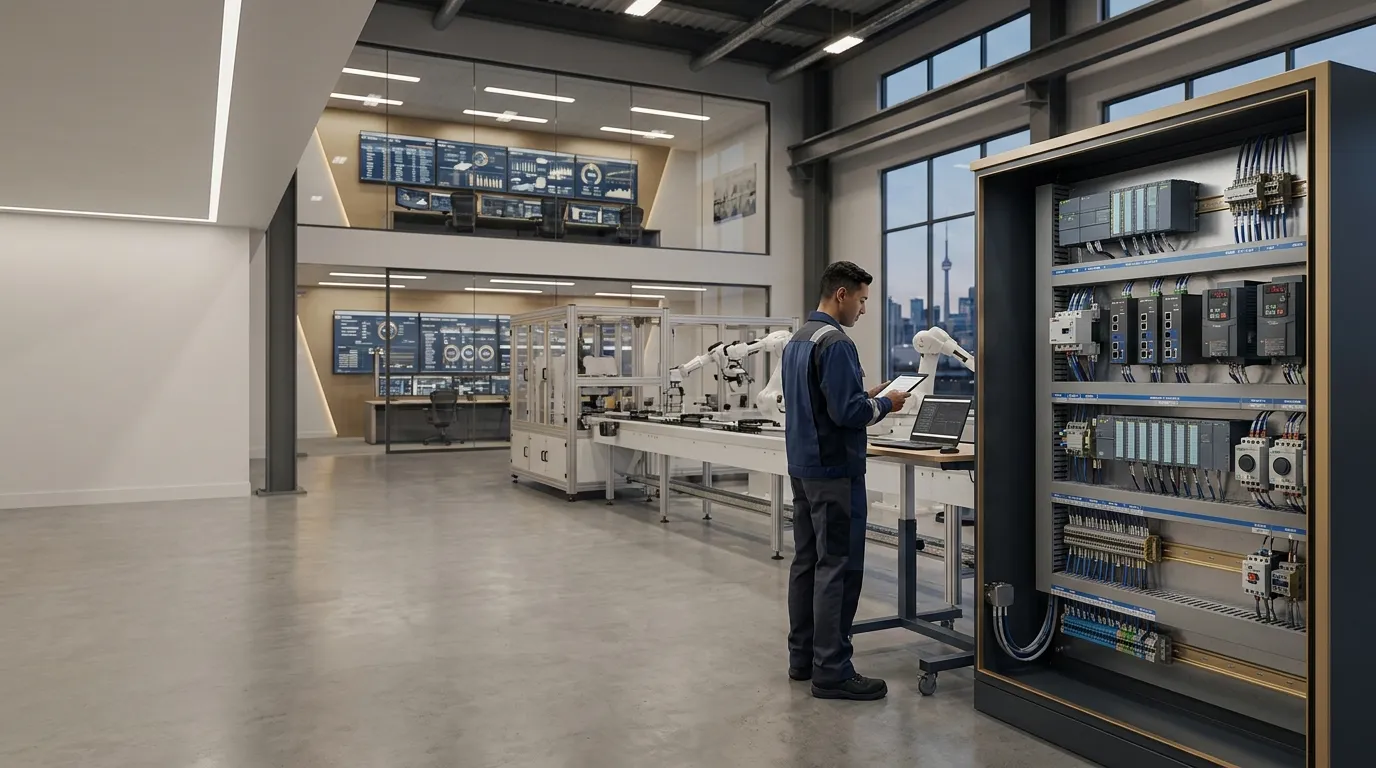
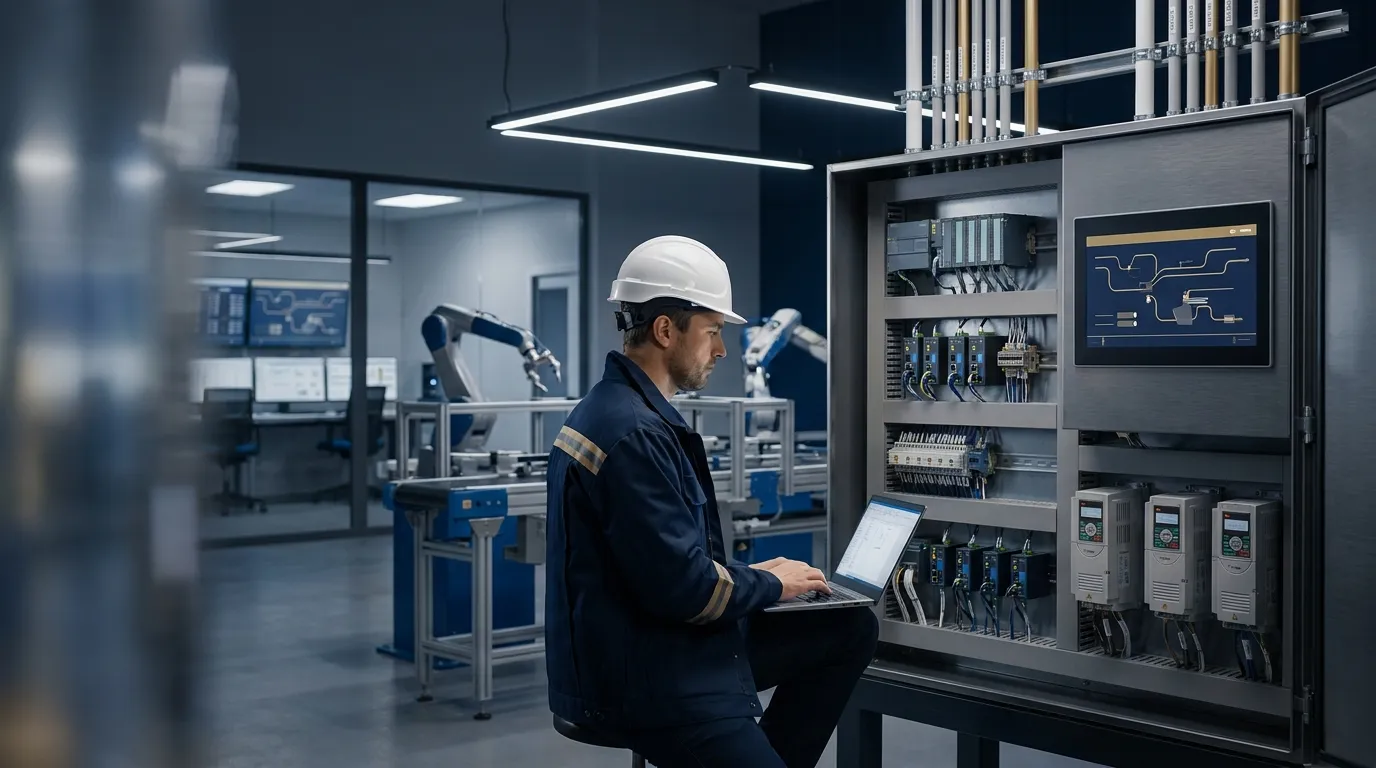
A modern automation system may include programmable logic controllers, human-machine interfaces, control panels, variable-frequency drives, sensors, industrial robots, SCADA platforms and production-data systems. Each component performs a different function, but the greatest value is usually achieved when the components operate as one coordinated system.
This guide explains how industrial automation works, the technologies involved, the difference between new systems and retrofits, the role of Industry 4.0 and IIoT, and the factors Toronto and Ontario facilities should consider before starting an automation project.
What Is Industrial Automation?
Industrial automation is the application of control technologies to operate machinery and processes with reduced dependence on continuous manual intervention. Sensors collect information from the process, controllers evaluate that information and output devices perform the required physical actions.
For example, an automated conveyor system may use sensors to detect products, a PLC to determine the correct sequence and motors or actuators to move each product. An HMI allows operators to view equipment status, while a SCADA system may collect information from several machines for centralized monitoring.
Industrial automation does not necessarily mean removing people from the process. In many facilities, automation gives operators better information, reduces repetitive tasks and helps maintenance teams identify equipment problems more efficiently.
Automation vs Mechanization
Mechanization uses powered equipment to help people perform work, while automation uses programmed control systems to perform decisions and sequences according to defined conditions. A powered conveyor is an example of mechanization. A conveyor that changes speed, routes products and stops automatically when a fault is detected is an automated system.
Industrial Automation vs Building Automation
Industrial automation generally controls production machinery and industrial processes. Building automation controls systems such as HVAC, lighting, energy monitoring and building access. Both use sensors, controllers and networks, but they operate under different technical, environmental and safety requirements.
How Does Industrial Automation Work?
An industrial automation system works through a continuous cycle of measurement, decision and action.
- Measurement: Sensors collect information such as temperature, pressure, position, speed, level or flow.
- Signal processing: Input modules convert field signals into information the controller can process.
- Control decision: A PLC or industrial controller executes programmed logic based on current conditions.
- Physical action: Output modules command motors, valves, actuators, heaters or other equipment.
- Operator visibility: An HMI displays status, alarms, trends and process values.
- Supervisory monitoring: A SCADA platform can collect and organize data from multiple controllers.
- Data analysis: Production information can be used for maintenance, quality and process-improvement decisions.
This cycle may occur many times per second, depending on the process and controller. The required response time varies significantly between applications. Motion control, safety functions, temperature regulation and production reporting do not all have the same timing requirements.
Main Components of an Industrial Automation System
Programmable Logic Controllers
A programmable logic controller, or PLC, is an industrial computer designed to monitor inputs and control outputs in real time. PLCs are widely used because they can operate in industrial environments and execute predictable control sequences.
PLC programs may contain:
- Machine operating sequences
- Start and stop conditions
- Timers and counters
- Manual and automatic operating modes
- Equipment permissives and interlocks
- Alarm and fault logic
- Analog process-control functions
- Communication with drives and other controllers
IEC 61131-3 defines widely used PLC programming languages, including Ladder Diagram, Function Block Diagram and Structured Text.
Human-Machine Interfaces
A human-machine interface, or HMI, allows operators and technicians to interact with a machine or process. The HMI reads information from the PLC and presents it through graphical screens.
An effective HMI may include:
- Machine and process overview screens
- Equipment status and operating modes
- Start, stop and setpoint controls
- Alarm summaries and histories
- Process trends
- Recipe or product selection
- Maintenance and diagnostic information
- Authorized user-access levels
A good interface should help users understand the process. Decorative animation and excessive colour should not make important conditions or alarms harder to identify.
SCADA Systems
Supervisory Control and Data Acquisition, or SCADA, provides centralized monitoring and supervisory control across machines, production areas or distributed facilities.
A SCADA platform may perform several functions:
- Collect real-time information from PLCs
- Display process and equipment status
- Generate and record alarms
- Store historical production data
- Display trends and performance reports
- Manage users and permissions
- Connect production data with other platforms
The PLC usually remains responsible for direct machine control. The SCADA system provides broader visibility, data storage and supervisory functions.
Industrial Control Panels
A control panel houses and organizes the electrical and automation components used by a machine or process. Depending on the application, a panel may contain PLC hardware, remote I/O, relays, power supplies, safety devices, motor starters, VFDs, terminals and industrial network switches.
Professional control-panel design should consider electrical protection, ventilation, wire management, labelling, maintenance access, environmental conditions and future expansion.
Sensors and Instrumentation
Sensors provide the information required for automated decisions. They can detect presence, position, pressure, temperature, level, flow, weight, vibration and many other physical conditions.
The controller must be programmed to respond appropriately when a sensor fails or reports an invalid value. A reliable control strategy should not assume that every field signal will always remain accurate.
Actuators, Motors and Drives
Output devices convert controller commands into physical action. These devices include motors, valves, pneumatic cylinders, hydraulic equipment, heaters and robotic systems.
Variable-frequency drives can control motor speed and provide diagnostic information such as frequency, current, operating status and fault conditions.
Industrial Networks
Industrial networks allow controllers, HMIs, drives, remote I/O and SCADA servers to exchange information. Technologies may include EtherNet/IP, PROFINET, Modbus TCP, Modbus RTU, OPC UA and other vendor-specific protocols.
Protocol compatibility alone does not guarantee complete integration. Device data maps, supported functions, timing requirements and failure behaviour must also be reviewed.
Levels and Types of Industrial Automation
Automation systems can be described by their flexibility and by their location within the manufacturing hierarchy.
Fixed Automation
Fixed automation is designed to perform a specific sequence at high production volume. It can provide fast and repeatable operation but may be difficult to adapt when the product or process changes.
Programmable Automation
Programmable automation allows the production sequence to be changed through software. It is commonly used for batch production and equipment that handles different products or recipes.
Flexible Automation
Flexible automation can change between products or operating conditions with limited manual reconfiguration. It may combine PLCs, robots, recipes, machine vision and production-management systems.
Field Level
The field level includes sensors, instruments, motors, valves and actuators that interact directly with the physical process.
Control Level
The control level includes PLCs, industrial controllers, remote I/O and control devices that execute process decisions.
Supervisory Level
The supervisory level includes HMIs and SCADA platforms used for operator interaction, alarms, monitoring and historical information.
Operations and Business Level
The upper levels can include manufacturing execution systems, maintenance platforms, analytics tools and enterprise systems. Connections between operational and business systems must be designed carefully to protect reliability and cybersecurity.
What Does an Industrial Automation Integrator Deliver?
An industrial automation integrator connects the control, electrical, software and communication components required to operate an industrial process. The integrator translates process requirements into a working and maintainable control system.
Typical responsibilities include:
- Assessing the current process and installed equipment
- Creating functional and control descriptions
- Selecting compatible automation hardware
- Developing PLC and HMI applications
- Integrating sensors, drives and field equipment
- Configuring industrial communication networks
- Developing or modernizing SCADA systems
- Testing sequences, alarms and interlocks
- Supporting installation and commissioning
- Producing application backups and documentation
An integrator should also identify project assumptions and technical risks. These may include unavailable PLC source files, obsolete hardware, undocumented field wiring, limited shutdown time or unsupported software versions.
New Automation Systems vs Retrofitting Existing Equipment
A new control system provides greater design freedom, while a retrofit allows a facility to retain suitable machinery and replace selected automation components.
| Project Type | Suitable Applications | Main Considerations |
|---|---|---|
| New Automation System | New machines, production lines and facilities. | Complete architecture, hardware selection, testing and future expansion. |
| Software Modification | Supported PLC or HMI systems requiring new functions. | Source files, software compatibility, testing and rollback. |
| Partial Retrofit | Reliable machinery with aging controllers, HMIs or networks. | Compatibility, retained equipment and staged commissioning. |
| Complete Controls Migration | Systems with obsolete hardware, repeated failures or major limitations. | I/O migration, code redevelopment, training and shutdown planning. |
When Does a Retrofit Make Sense?
A retrofit may be appropriate when the machine remains mechanically reliable but the control hardware is becoming difficult to maintain. It can also help facilities improve diagnostics, add data collection or connect older equipment with newer plant systems.
When Is Full Replacement More Practical?
Full replacement may be preferable when source code is unavailable, hardware failures are increasing, replacement parts are difficult to obtain or the existing architecture cannot support required improvements.
An automatic code conversion should not be treated as final commissioning-ready software. Converted logic must still be reviewed and tested against the actual machine operation.
Industry 4.0, IIoT, OEE and Process Optimization
What Is Industry 4.0?
Industry 4.0 describes the use of connected automation, production data and digital technologies to create more visible and adaptable industrial operations. Technologies may include IIoT devices, industrial data platforms, digital work instructions, machine learning and production analytics.
What Is IIoT?
The Industrial Internet of Things connects industrial equipment and sensors with systems that collect, organize or analyze operational data. An IIoT project should be based on a defined production or maintenance objective rather than connecting equipment without a clear use case.
Useful questions for an IIoT project include:
- Which assets cause the most downtime?
- Which alarms occur repeatedly?
- How long do production changeovers take?
- Is equipment operating outside its expected range?
- Which process conditions affect product quality?
- Where is production performance being lost?
What Is OEE?
Overall Equipment Effectiveness, or OEE, combines availability, performance and quality to evaluate how effectively production equipment is being used.
OEE = Availability × Performance × Quality
- Availability: How much scheduled production time the equipment was operating.
- Performance: How closely actual production speed matched the expected speed.
- Quality: How much of the produced output met quality requirements.
OEE results are only useful when downtime, rejected products, production counts and planned stops are defined consistently.
Process Optimization
Automation data can help identify bottlenecks, unstable process conditions, recurring equipment faults and inefficient sequences. Improvements may involve changing control logic, refining setpoints, improving alarms or coordinating machines more effectively.
Any process change should be tested against production, mechanical, quality and safety requirements before deployment.
SCADA Virtualization, Industrial Networking and OT Cybersecurity
SCADA Virtualization
SCADA virtualization moves compatible server workloads from dedicated physical computers to managed virtual infrastructure. Potential benefits include simpler hardware recovery, organized backups, improved resource use and easier creation of test environments.
Virtualization requires a technical assessment covering vendor support, software licensing, communication hardware, redundancy, storage, network architecture and recovery requirements.
Industrial Network Segmentation
Network segmentation separates systems according to their operational role and communication requirements. It can limit unnecessary traffic and reduce the number of devices that can communicate directly with critical controllers.
An industrial network plan should document:
- Connected assets and IP addresses
- Required communication paths
- Protocols and ports
- Switch and network configurations
- Connections between IT and OT systems
- Remote-access methods
- Redundancy and recovery procedures
OT Cybersecurity
Operational technology includes programmable systems that interact with physical equipment and processes. NIST recommends protecting OT while considering its particular performance, safety, reliability and availability requirements.
Common security practices include:
- Maintaining an inventory of controllers and industrial devices
- Restricting engineering access
- Separating IT and OT systems where appropriate
- Removing unnecessary internet exposure
- Controlling and monitoring remote access
- Maintaining verified offline backups
- Managing user accounts and permissions
- Reviewing updates before production deployment
- Preparing incident-response and recovery procedures
Cybersecurity changes must be tested because an unsuitable update or configuration can interrupt production even when it was intended to improve security.
How an Industrial Automation Project Is Completed
1. Process Assessment
The project begins by documenting how the process currently operates, what problems must be solved and how success will be measured.
2. Existing-System Review
The team collects PLC and HMI files, controller information, electrical drawings, I/O lists, device configurations and industrial network details.
3. Functional Design
A functional description defines the required sequences, operating modes, alarms, interlocks and failure responses before programming begins.
4. Hardware and Network Design
Controllers, modules, panels, network equipment and field devices are selected according to process, environmental and maintenance requirements.
5. PLC, HMI and SCADA Development
Applications are developed and reviewed offline where practical. Consistent naming, reusable programming structures and clear documentation can simplify future maintenance.
6. Factory Acceptance Testing
Factory acceptance testing verifies application functions before on-site deployment. It can include sequence testing, simulated I/O, alarms, HMI navigation and communication checks.
7. Installation and Site Testing
Physical I/O, device communications, motor directions, instrumentation and control functions are verified after installation.
8. Commissioning
The system is tested under actual operating conditions. Commissioning should include abnormal conditions and recovery behaviour, not only successful normal operation.
9. Training and Handover
Operators and maintenance personnel receive the agreed training, backups and technical documentation.
10. Lifecycle Support
The facility maintains application backups, records modifications, reviews recurring faults and plans for components approaching obsolescence.
Potential Benefits of Industrial Automation
The benefits of automation depend on the process and how successfully the system is designed and maintained. Automation alone does not guarantee better performance.
Potential benefits include:
- More consistent production sequences
- Improved process visibility
- Faster identification of equipment faults
- Reduced manual and repetitive tasks
- Improved production-data collection
- Better alarm and event records
- More controlled product changeovers
- Improved use of equipment and energy
- Better maintenance planning
- Greater scalability for future production requirements
How Should Automation Performance Be Measured?
Performance should be measured against a documented baseline. Useful indicators may include:
- Unplanned downtime
- Production throughput
- Cycle time
- Changeover duration
- Quality and rejection rates
- Alarm frequency
- Maintenance response time
- Energy consumption per production unit
- Mean time between failures
- Mean time to repair
The selected indicators should relate directly to the original project objective.
Common Industrial Automation Challenges
Incomplete Documentation
Missing PLC files, inaccurate drawings and undocumented modifications can increase project time and commissioning risk. Existing systems should be documented before major changes begin.
Obsolete Hardware
An old controller may still operate reliably but become difficult to support. Facilities should identify critical obsolete equipment before a failure forces an emergency migration.
Limited Shutdown Windows
Short shutdowns require detailed preparation, offline programming, spare hardware, pre-tested configurations and a defined rollback plan.
Integration Between Different Vendors
Controllers and devices from different manufacturers may support the same communication protocol but expose different data and functions. Compatibility must be verified at the application level.
Cybersecurity and Remote Access
Uncontrolled remote connections can expose critical systems. Remote access should be authorized, restricted, monitored and disabled when it is no longer required.
Lack of Training
Operators and maintenance personnel need to understand new screens, alarms and recovery procedures. A technically advanced system can still perform poorly if the people using it are not adequately prepared.
Industrial Automation Cost and Planning Factors
There is no standard price for every industrial automation Toronto project. A PLC software modification and a multi-line SCADA migration require very different engineering, hardware and commissioning resources.
Important cost factors include:
- Number of machines, controllers and I/O points
- Condition of existing hardware and wiring
- Availability of source files and drawings
- PLC, HMI and SCADA programming requirements
- Control-panel modifications or replacement
- Industrial network and cybersecurity requirements
- Number of connected drives and field devices
- Data collection and reporting requirements
- Factory and site acceptance testing
- Approved shutdown schedule
- After-hours or weekend commissioning
- Training, documentation and ongoing support
A useful project proposal should define the included work, deliverables, assumptions, exclusions and responsibilities. Unknown conditions in a legacy system should also be addressed before commissioning begins.
How to Choose an Industrial Automation Integrator
Facilities should evaluate an integrator based on engineering process, documentation, testing and support rather than relying only on the initial price.
Questions to ask include:
- Will the existing system be assessed before changes are recommended?
- Which PLC, HMI and SCADA platforms are supported?
- How will current programs and configurations be backed up?
- Will a functional description be created or reviewed?
- How will normal and abnormal operating conditions be tested?
- What is the shutdown and rollback strategy?
- Which files and documents will be provided after commissioning?
- Who will own the final source files?
- How will remote access be secured?
- What support is available after production startup?
Industrial Automation Toronto FAQs
Who provides industrial automation services in Toronto?
Industrial automation services are provided by control-system integrators and automation engineering companies. Smartopia supports Toronto, GTA and Ontario facilities with PLC and HMI programming, control-system integration, SCADA modernization, industrial networking, testing and commissioning.
What does an industrial automation integrator do?
An integrator assesses the process, defines the control architecture, programs PLC and HMI systems, connects field devices, configures industrial networks and tests the completed system. The integrator may also provide documentation, training and lifecycle support.
Can an existing PLC system be upgraded without replacing all equipment?
Yes. Many systems can be upgraded in stages by retaining suitable machinery, wiring or field devices. The decision depends on hardware condition, source-code availability, compatibility, safety requirements and long-term support.
What is the difference between PLC, HMI and SCADA?
A PLC executes real-time control logic. An HMI allows an operator to view and control a machine. SCADA provides centralized monitoring, alarms, history and supervisory control across multiple controllers or processes.
What are the benefits of SCADA virtualization?
SCADA virtualization may simplify hardware recovery, backups, test environments and future expansion. Compatibility, licensing, redundancy, network architecture and vendor support must be reviewed before migration.
How can an automation upgrade be completed with minimal downtime?
Downtime may be reduced through verified backups, offline development, simulation, preassembled panels, staged installation and a tested rollback plan. The required shutdown cannot be confirmed until the existing system is assessed.
What testing is completed before commissioning?
Testing may include PLC sequence verification, HMI testing, simulated I/O, alarm and interlock checks, communication testing, loop checks, factory acceptance testing and site acceptance testing.
What documentation should be provided after commissioning?
The handover package may include final PLC, HMI and SCADA backups, I/O lists, network settings, alarm and interlock descriptions, test records, commissioning results and recovery instructions.
Which industries use industrial automation?
Industrial automation is used in manufacturing, food processing, pharmaceuticals, logistics, packaging, water treatment, energy, automotive production and material-handling operations.
Final Considerations
Successful industrial automation begins with a clear understanding of the process rather than a specific technology or product. PLCs, HMIs, SCADA platforms, control panels and industrial networks must be selected and configured around operational requirements.
Facilities should also plan for testing, documentation, cybersecurity, staff training and future hardware obsolescence. These factors determine whether an automation system remains reliable after the initial commissioning period.
For additional technical information, review Smartopia’s industrial automation capabilities and our guide to integrated technology systems.
Discuss an Industrial Automation Project
Smartopia supports facilities evaluating PLC programming, HMI development, SCADA modernization, industrial networking and legacy-system integration across Toronto and Ontario.
Sources and Technical References
- International Electrotechnical Commission: IEC 61131-3:2025—Programmable Controller Programming Languages
- National Institute of Standards and Technology: Guide to Operational Technology Security
- CISA: Industrial Control Systems Recommended Practices
- Government of Ontario: Regulation 851—Industrial Establishments
- Government of Ontario: Guideline for Pre-Start Health and Safety Reviews
- Rockwell Automation: Studio 5000 Logix Designer Documentation
- Siemens: STEP 7 TIA Portal Documentation
This article provides general educational information. Project-specific machinery safety, electrical work, programming and regulatory requirements must be evaluated by appropriately qualified professionals.

Comments are closed