
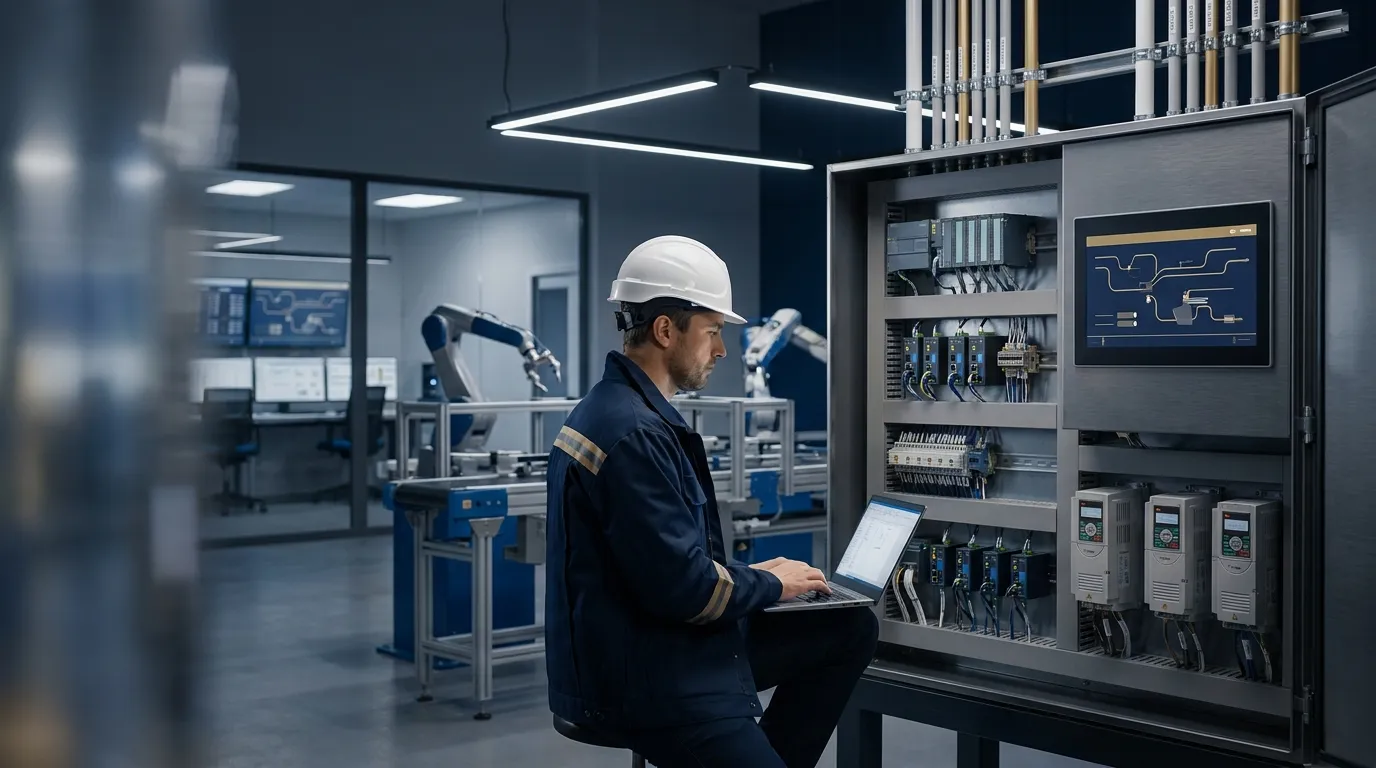
Smartopia supports industrial facilities across Toronto, the Greater Toronto Area and Ontario with coordinated automation solutions. Our approach considers the complete operational environment, including existing equipment, production requirements, safety functions, network architecture, available shutdown windows and long-term maintenance needs.
Learn more about our industrial automation services in Toronto and Ontario or request an automation assessment.
What Do PLC Programming Services in Ontario Include?
Professional PLC programming services can cover the complete control-system lifecycle, from initial process assessment and logic development to testing, startup and ongoing troubleshooting. The exact scope depends on whether the project involves a new machine, an existing production line, obsolete hardware or integration with a larger SCADA system.
| Project Stage | Typical Work | Expected Deliverables |
|---|---|---|
| Assessment | Review the process, PLC hardware, field devices, networks, existing code and operational problems. | System findings, risks, compatibility requirements and recommended scope. |
| Engineering | Develop control narratives, sequences, I/O requirements, alarms, interlocks and communication architecture. | Functional description, I/O list, network plan and programming requirements. |
| Programming | Create or modify PLC logic, HMI screens, alarms, recipes, trends and equipment interfaces. | PLC program, HMI application, configuration files and controlled backups. |
| Testing | Verify sequences, permissives, interlocks, alarms, communication paths and failure responses. | Test records, issue list and approved corrections. |
| Commissioning | Deploy the program, test physical I/O, confirm equipment operation and support production startup. | Commissioning records, final backups and operating documentation. |
| Lifecycle Support | Provide troubleshooting, controlled modifications, backup management and modernization planning. | Updated files, change records and improvement recommendations. |
PLC programming should not be treated as an isolated software task. Logic changes can affect motors, valves, conveyors, robots, safety devices and production quality. A responsible integrator reviews the complete process before modifying a running industrial control system.
PLC Logic Development, HMI Programming and Troubleshooting
PLC Logic Development
A programmable logic controller continuously reads field inputs, executes programmed instructions and updates outputs that control industrial equipment. PLC logic may manage machine sequences, timers, counters, permissives, alarms, operating modes, equipment interlocks and communication with other controllers.
Maintainable PLC programming normally uses consistent naming, organized routines, reusable functions, clear comments and defined operating states. The goal is not simply to make the machine run. The program should also help technicians understand the process, identify faults and make approved changes without creating unnecessary risk.
The current IEC 61131-3 standard defines programming languages for programmable controllers, including Ladder Diagram, Function Block Diagram and Structured Text. The most suitable language or combination of languages depends on the controller, application, maintenance team and established plant standards.
HMI Programming and Operator Interface Design
A PLC controls the process, while a human-machine interface presents information and allows authorized operators to interact with that process. An effective HMI can display machine status, process values, alarms, trends, recipes, production counters and diagnostic information.
HMI programming should prioritize clarity and predictable navigation. Operators need to identify abnormal conditions quickly, understand why equipment cannot start and access the information required to respond safely. Excessive animation, colour or unnecessary data can make an interface harder to use during a production problem.
Common HMI development tasks include:
- Overview, equipment and process screens
- Start, stop, mode and setpoint controls
- Alarm summaries and alarm history
- Trends and historical process values
- Recipe and product-selection functions
- User access levels and operator permissions
- Maintenance and diagnostic screens
- Communication-loss and device-fault indications
PLC Troubleshooting
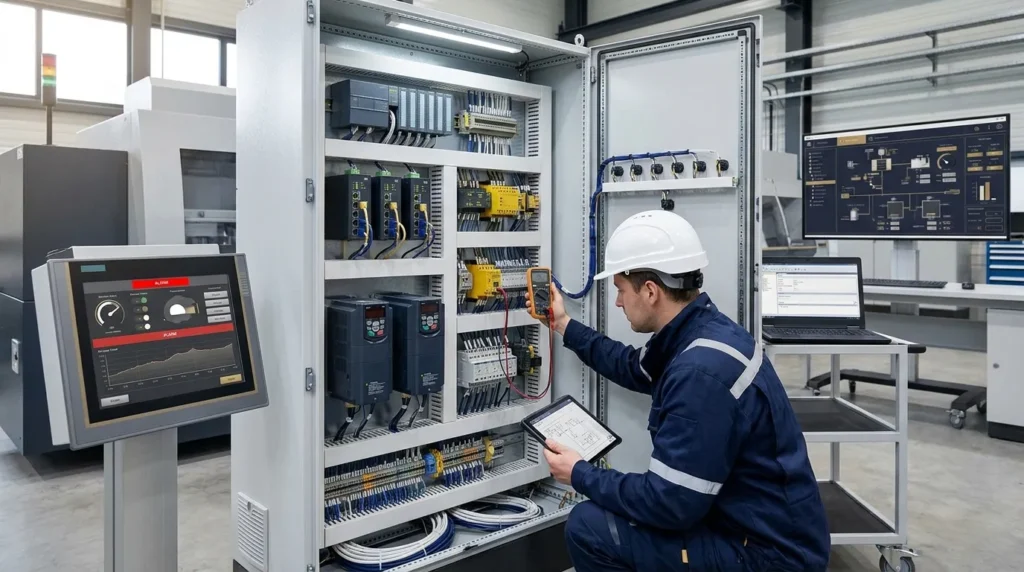
PLC troubleshooting begins by identifying whether a problem comes from the control logic, field wiring, instrumentation, communication network, mechanical equipment or operating process. Replacing a controller or changing code before confirming the cause can add downtime without resolving the original fault.
A structured investigation may review controller status, fault logs, I/O states, alarm history, network diagnostics, device feedback and the sequence conditions required for the affected equipment to operate. Before any modification, the current PLC and HMI files should be backed up and their compatibility with the installed hardware confirmed.
New PLC Programming vs Legacy PLC Retrofit
A new PLC system offers greater design flexibility, while a legacy retrofit preserves suitable machinery and replaces selected control components. The right approach depends on hardware condition, software availability, spare-part support, production risk, documentation quality and the expected remaining life of the equipment.
| Approach | Best Suited For | Important Considerations |
|---|---|---|
| New PLC System | New machines, production lines and facilities requiring a complete control architecture. | Process definition, hardware selection, panel requirements, testing and startup schedule. |
| PLC Program Modification | Supported controllers requiring new sequences, diagnostics, recipes or process improvements. | Reliable source files, version control, testing, safety review and rollback planning. |
| Partial Controls Retrofit | Mechanically sound equipment with an aging PLC, HMI, VFD or communication system. | Compatibility, conversion quality, retained wiring and phased commissioning. |
| Full Controls Migration | Obsolete systems with limited support, recurring failures or major operational restrictions. | I/O migration, code redevelopment, operator training, shutdown duration and spare hardware. |
A legacy PLC should not be replaced solely because it is old. The integrator should first determine whether the controller is stable, whether verified source code is available, whether programming software can still access it and whether replacement parts remain practical to obtain.
When modernization is justified, offline development and staged migration can reduce the amount of work performed during the shutdown. Existing sequences should be documented and tested instead of assuming that an automatic code-conversion utility will reproduce every behaviour correctly.
Facilities considering a wider controls upgrade can review Smartopia’s PLC programming, control-panel and industrial-system capabilities.
Integrating PLCs with SCADA, VFDs, Sensors and Industrial Networks
PLC programming services in Ontario frequently involve more than a single controller. Modern industrial systems connect PLCs with HMIs, SCADA servers, remote I/O, variable-frequency drives, instrumentation, robots, safety systems and plant-level reporting platforms.
SCADA Integration
SCADA integration allows authorized teams to monitor equipment, alarms, process values and historical trends from a centralized platform. The PLC remains responsible for time-sensitive machine control, while the SCADA system provides supervisory visibility, data collection and operator interaction.
A SCADA integration project may include tag mapping, alarm configuration, historian connections, screen development, user permissions, redundancy planning and communication testing. Tag names, engineering units, alarm priorities and controller addresses should be documented so that future support does not depend on undocumented knowledge.
VFD, Sensor and Field-Device Integration
PLCs can exchange commands and operating data with variable-frequency drives, motor controllers, instrumentation and intelligent sensors. Integration may provide speed commands, process values, device status, fault codes and maintenance information.
Before connecting a field device, the integrator should confirm its electrical requirements, supported protocol, data mapping, update rate and failure behaviour. Critical equipment must also have clearly defined responses to communication loss, invalid data and device faults.
Industrial Network Integration
Industrial networks may use Ethernet-based and serial communication technologies to connect controllers, drives, remote I/O and supervisory systems. Network design should account for device compatibility, traffic, segmentation, physical conditions, redundancy and access requirements.
Common integration protocols can include EtherNet/IP, PROFINET, Modbus TCP, Modbus RTU, OPC UA and other platform-specific technologies. Protocol availability does not guarantee that two devices will exchange all required information, so register maps, device profiles and supported functions must be verified during engineering.
For projects that combine automation, networking and plant-level systems, explore Smartopia’s integrated technology solutions.
OT Cybersecurity for PLC and SCADA Systems
Industrial control systems require cybersecurity measures that respect their safety, reliability and availability requirements. NIST identifies PLCs, SCADA systems and other programmable industrial equipment as operational technology that interacts with physical processes.
Practical safeguards may include:
- Separating business and operational networks where appropriate
- Restricting engineering access to authorized personnel
- Using controlled and monitored remote-access methods
- Maintaining verified offline backups of PLC and HMI applications
- Recording software, firmware and configuration versions
- Removing unnecessary internet exposure
- Managing accounts, passwords and user permissions
- Reviewing updates before deployment to production systems
- Maintaining an incident-response and recovery plan
Cybersecurity changes should be tested before implementation because an industrial environment cannot always adopt the same update schedule or controls used for ordinary office IT. The consequences of a failed change may include lost visibility, equipment interruption or an unsafe process condition.
PLC Testing, Documentation, Commissioning and Change Management
Testing and documentation are essential parts of professional PLC programming. A program that works during one startup but cannot be understood, restored or supported later creates long-term operational risk.
A Structured PLC Project Process
- Define the process: Confirm operating sequences, production objectives, equipment states and operator responsibilities.
- Document the existing system: Collect controller models, software versions, backups, I/O information, drawings and network details.
- Assess risk: Identify production, safety, quality, cybersecurity and compatibility risks before changing the system.
- Develop offline: Create and review logic, HMI screens and communication configurations before the approved installation window.
- Test the application: Verify normal sequences, alarms, interlocks, invalid conditions and equipment responses.
- Commission on site: Confirm physical I/O, device communication, operating modes and production performance.
- Complete the handover: Provide final backups, approved documentation, change records and operator guidance.
Factory and Site Testing
Factory acceptance testing can verify application logic, HMI functions, simulated I/O, communications and documented requirements before equipment reaches the production environment. Site acceptance testing confirms the installed system under actual site conditions.
The test plan should define who participates, what will be tested, the expected results and how unresolved items will be tracked. Testing should cover normal operation as well as communication loss, failed devices, invalid inputs, restart behaviour and recovery after power interruption where applicable.
Recommended Handover Documentation
- Final PLC and HMI application backups
- Controller, module and software-version records
- I/O lists and device-address information
- Network architecture and communication settings
- Alarm, interlock and permissive descriptions
- Functional or sequence-of-operation documentation
- Test and commissioning records
- Known limitations and outstanding action items
- Recovery and rollback instructions
- Approved change history
Change Management
Every production change should have a defined objective, authorized scope, current backup, test method and rollback plan. The final program should be uploaded and compared after commissioning so the archived copy accurately represents the running controller.
Safety-related logic, machine guarding and lockout requirements require particular care. Ontario industrial facilities must identify the regulations and professional responsibilities applicable to their equipment and workplace. Control-system programming should never be used as a substitute for required safeguarding, electrical work or safe work procedures.
PLC Programming Cost, Downtime Planning and Choosing an Integrator
What Determines PLC Programming Cost?
There is no reliable single price for every PLC programming project. A minor diagnostic visit and a multi-controller migration involve very different engineering, testing and commissioning requirements.
Important cost factors include:
- Number and type of PLCs, HMIs and field devices
- Availability and quality of the existing source files
- Complexity of the machine or process sequence
- Quantity of I/O points and communication interfaces
- Condition of drawings and technical documentation
- Required SCADA, historian, database or reporting integration
- Obsolete hardware and software compatibility
- Simulation, FAT and on-site testing requirements
- Travel, after-hours work and approved shutdown windows
- Operator training and final documentation
- Ongoing support and response-time requirements
A useful proposal should define assumptions, exclusions, responsibilities and deliverables. If the condition of a legacy system cannot be confirmed before work begins, the proposal should explain how discoveries and additional work will be handled.
How Can PLC Work Be Completed with Less Downtime?
Downtime can often be reduced through site assessment, verified backups, offline development, simulation, spare hardware, staged installation and an approved rollback plan. However, no responsible integrator should promise zero downtime before evaluating the equipment and required changes.
Where practical, the team can complete documentation, panel preparation, application development and communication testing before the shutdown. The final schedule should include time for startup checks and production verification instead of assuming that successful program download equals successful commissioning.
Questions to Ask a PLC Programming Company
- Have you reviewed the existing hardware, software and source-code availability?
- Which controller and HMI platforms are included in the proposed scope?
- How will current programs and configurations be backed up?
- Which tests will be completed before and during commissioning?
- How will safety-related functions and operational risks be handled?
- What is the planned shutdown and rollback strategy?
- Which drawings, backups and reports will be delivered?
- Who owns and receives the final source files?
- How are emergency support and future modifications managed?
- How will remote access and OT cybersecurity be controlled?
PLC and HMI Platforms an Automation Integrator May Support
Platform support depends on the integrator’s experience, available software, licenses, controller generation and access to the correct project files. Common industrial ecosystems include Rockwell Automation or Allen-Bradley, Siemens SIMATIC, Schneider Electric Modicon and Omron controllers, along with their associated HMI and engineering environments.
Before starting a project, the exact controller model, firmware, communication modules, HMI platform and programming-software version should be confirmed. This is especially important for legacy systems because an application created in one software release may not open or download correctly using another release.
Smartopia evaluates platform compatibility and project requirements before confirming the final programming and integration scope.
Industries That Use PLC Programming Services in Ontario
PLC programming and industrial automation can support facilities that require repeatable machine control, process monitoring, production visibility or coordinated equipment operation.
- Manufacturing and assembly
- Food and beverage processing
- Pharmaceutical and life-science facilities
- Warehousing and logistics
- Material-handling and conveyor systems
- Water and wastewater operations
- Energy and utility systems
- Packaging and processing equipment
- Automotive and component production
- Commercial and institutional central plants
Every industry has different production, environmental, documentation and compliance requirements. The automation design should therefore be based on the actual process instead of applying the same programming template to every facility.
Why Work with Smartopia?
Smartopia approaches industrial automation as part of a connected technology environment. PLCs, HMIs, SCADA platforms, control panels, industrial networks and plant information systems must work together if the facility is to achieve dependable operation and maintainable growth.
Our project approach emphasizes:
- Assessment before programming or replacement
- Clear project scope and integration responsibilities
- Maintainable PLC and HMI development
- Testing and controlled commissioning
- Structured backups and technical documentation
- Practical modernization and phased migration planning
- Coordination between automation and network requirements
- Long-term lifecycle and support considerations
Read more about why organizations choose Smartopia for coordinated technology integration.
PLC Programming Services Ontario FAQs
Who provides PLC programming services in Ontario?
Smartopia provides PLC programming, HMI development, troubleshooting, control-system integration and SCADA modernization support for industrial facilities in Toronto, the GTA and Ontario. The final service scope is confirmed after reviewing the installed equipment, software, process requirements and production risks.
Which PLC and HMI platforms can an automation integrator support?
Platform support varies by integrator and project. Common ecosystems include Rockwell Automation or Allen-Bradley, Siemens SIMATIC, Schneider Electric Modicon and Omron. The controller model, firmware, engineering software, licenses and available source files must be verified before support is confirmed.
Can an existing PLC be repaired without stopping the entire production line?
Some faults can be diagnosed while production continues, and certain systems permit controlled online changes. Other repairs require equipment isolation or a planned shutdown. The decision depends on the fault, controller, process risk, safety requirements and whether the proposed change can be tested safely.
What is the difference between PLC and HMI programming?
PLC programming creates the logic that monitors inputs and controls machinery or processes. HMI programming creates the operator interface used to view status, alarms and process values or issue authorized commands. The two applications exchange data but serve different functions.
What determines the cost of PLC programming services?
Cost depends on the number of controllers and devices, code complexity, documentation quality, source-file availability, required integrations, testing, travel, shutdown schedule and commissioning support. A technical assessment is usually required before an accurate scope and price can be established.
Can a legacy PLC be integrated with a modern SCADA system?
In many cases, yes. Integration may use an existing supported protocol, a communication gateway or a phased controller migration. Compatibility, data availability, reliability and cybersecurity risks must be assessed before selecting the integration method.
How long does a PLC programming project take?
A small modification may require a short engineering and commissioning window, while a complete migration can require weeks or months of assessment, development, testing and staged implementation. The schedule depends on system complexity, documentation, equipment availability and approved production shutdowns.
What should be backed up before changing a PLC?
The team should preserve the current PLC application, HMI project, controller configuration, communication settings, device parameters and available drawings. Backup files should be verified, labelled with the correct version and stored in a controlled location before changes begin.
Plan Your PLC Programming Project in Ontario
Whether your facility needs PLC troubleshooting, HMI development, a legacy controls retrofit or integration with SCADA and industrial networks, the first step is to document the current system and define the operational objective.
Contact Smartopia to discuss PLC programming services in Ontario, available shutdown windows, platform compatibility and the required testing and documentation for your facility.
Sources and Technical References
- International Electrotechnical Commission: IEC 61131-3:2025, Programmable Controllers—Programming Languages
- National Institute of Standards and Technology: SP 800-82 Rev. 3, Guide to Operational Technology Security
- Cybersecurity and Infrastructure Security Agency: Industrial Control Systems Recommended Practices
- Government of Ontario: Regulation 851, Industrial Establishments
- Government of Ontario: Guideline for Pre-Start Health and Safety Reviews
- Rockwell Automation: Studio 5000 Logix Designer Documentation
- Siemens: STEP 7 TIA Portal PLC Programming Software
This article provides general information about industrial automation projects. Project-specific programming, electrical work, machinery safety and regulatory requirements must be evaluated by appropriately qualified professionals.

Comments are closed